
QDL in 5 Minutes
The Quantized Dimensional Ledger (QDL) is a proposed structural admissibility framework for dimensional reasoning. It asks, before fitting or deployment, whether a construction is structurally coherent under declared dimensional rules and transformations. The intended role is upstream of dynamics: a filter on admissible representations, not a replacement for established physical theories.
1) What problem does QDL address?
In complex physical and model-driven systems, errors often arise before calibration or optimization: inconsistent dimensional structure, hidden representational assumptions, invalid transformations, or extrapolations beyond the regime where a model remains meaningful.
- Unit and scale inconsistencies that slip through review
- Mathematically permitted constructions that may still be structurally inadmissible
- Extrapolations that silently leave a valid regime
- Transformations that erode traceability or physical meaning
2) What is the core idea?
QDL treats admissibility as a structural question. Instead of asking only whether a model can be fitted or numerically tuned, QDL asks first whether the dimensional construction itself remains coherent under declared rules.
Is this construction structurally admissible before we fit, optimize, certify, or deploy it?
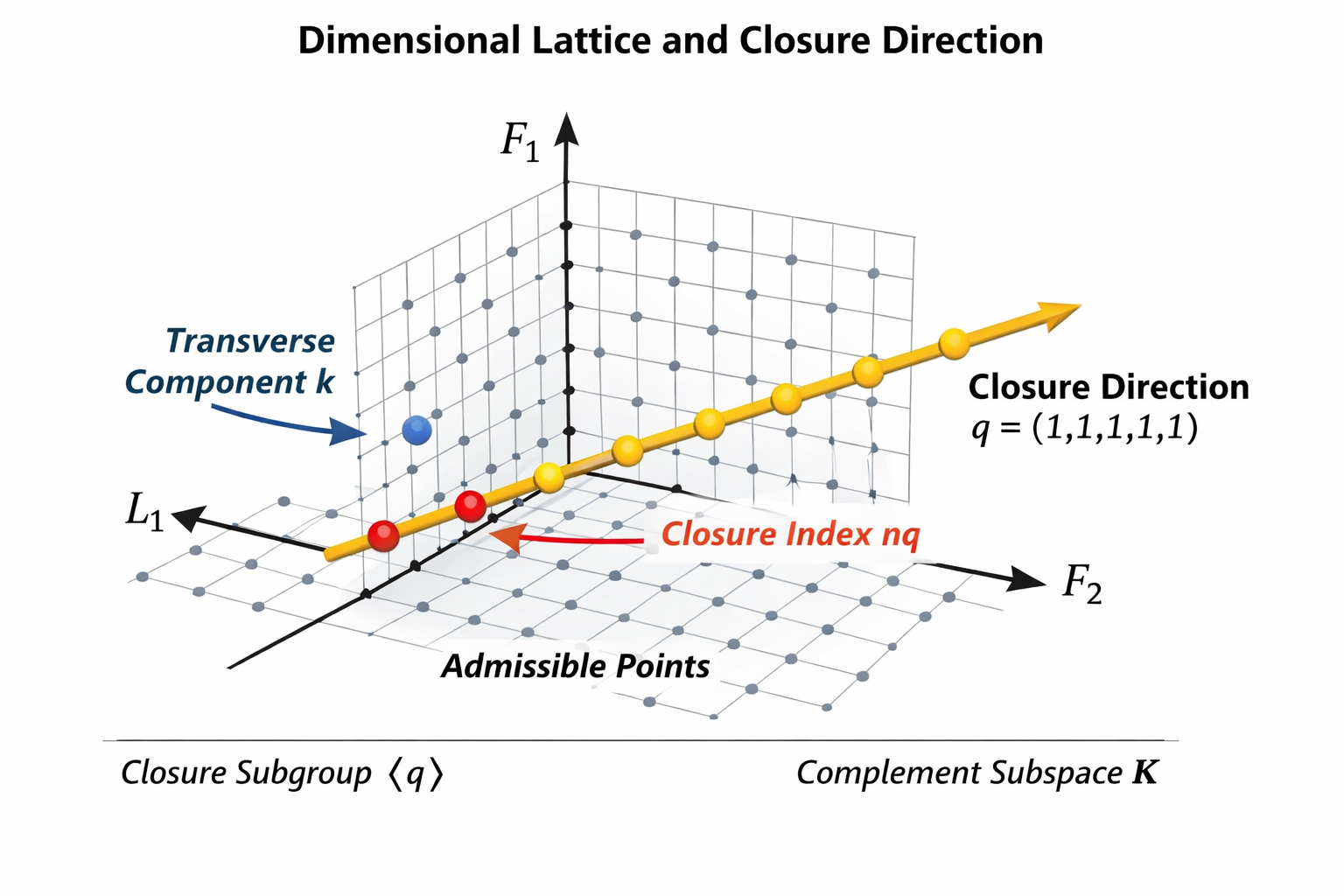
In the formal papers, this is expressed using an integer lattice representation of dimensional quantities and a closure condition relative to a distinguished Quantized Dimensional Cell (QDC). On this page, the key point is simpler: QDL aims to make structural coherence explicit and reviewable.
3) What does QDL do in practice?
- Flags structural inadmissibility early before downstream validation work
- Makes hidden assumptions explicit and easier to audit
- Clarifies regime boundaries where extrapolation becomes structurally risky
- Supports measurement-chain integrity across transformations and conversions
- Provides a consistent review language for dimensional coherence
4) Where can it apply?
QDL is intended as a cross-domain framework wherever dimensional structure matters.
- Metrology and standards for unit coherence and transformation traceability
- Physics and EFT/SMEFT for structural constraints on operator constructions
- Engineering and safety-critical modeling for explicit regime boundaries
- AI connected to measurement for sensor-to-decision pipeline integrity
- Model governance where decision quality depends on representational robustness
5) What QDL is not
- Not a replacement for quantum field theory, general relativity, or statistics
- Not a data-fitting method
- Not a claim of new particles, forces, or dynamics
- Not dependent on one specific dataset or one application area
Bottom line QDL is a structural admissibility filter: it helps determine whether a proposed construction is coherent before major effort is invested in validation, certification, or deployment.
6) Why might this matter?
If dimensional closure proves robust across relevant model classes and applications, QDL could strengthen dimensional reasoning from a bookkeeping check into a more explicit structural filter on admissible representations.
For collaboration or a pilot use case, contact [email protected].